

Professor Leonard – Calculus 3 – 12.3/12.5: TNB (Frenet-Serret) Frames, Curvature, Torsion, Encapsulation
Thomas – 13.4 Curvature and Normal Vectors of a Curve; 13.5 Tangential and Normal Components of Acceleration
TNB Frames
TNB Frames, also known as Frenet-Serret frames, describe how a particle moves along a space curve. They tell us the direction a particle is heading, turning, and twisting. These directions are described by the unit tangent vector T (the direction of motion), the unit normal vector N (the direction the curve is turning), and the binormal unit vector B (perpendicular to T and B, i.e. the twisting). Together, the mutually orthogonal T, N, and B form a moving coordinate system attached to the curve.
Given a vector-valued function r(t), that gives the position of a point (or particle) at a time t, the tangent unit vector
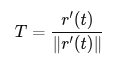
is equal to the derivative of r(t) divided by its magnitude. The unit normal vector
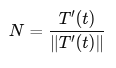
is equal to the derivative of the unit tangent vector divided by its magnitude. And the binormal unit vector
B = T x N
is equal to the cross product of the unit tangent vector and the unit normal vector.
Curvature
A TNB Frame tells us how a curve is oriented at any given point. T, N, and B are the vectors that we can use to determine the path of the function r(t) over time. We may also want to know how sharply the curve bends. Curvature measures how quickly a curve changes direction. A straight line has zero curvature, a gently bending curve has small curvature, and a sharply bending curve has large curvature. More formally, curvature, as measured by k (kappa) measures how quickly the tangent vector changes as we move along the curve:
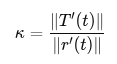
Radius of Curvature and the Osculating Circle
At any point on a curve, we can imagine the circle that best matches the curve at that location. That circle is our osculating circle. At the point of contact, the curve and the osculating circle share the same tangent direction and the same curvature. Additionally, we can draw a normal vector from the point on the curve to the center of the osculating circle. A highly curved path produces a small osculating circle, and a gently curved path a large osculating circle. The radius of the osculating circle is aptly called the radius of curvature, and is given by

As we noted, large curvature fits with small osculating circles, and vice versa. Thus, large curvature corresponds to small radii of curvature, and vice versa.
Osculating Plane
An osculating plane is the plane that best fits the curve at a given point, and is framed by the unit tangent vector T and unit normal vector N. As a particle moves along a curve, the osculating plane contains the direction the particle is heading and the direction it is turning. The osculating plane is equal to span(N, B).
Normal Plane
The normal plane is the plane perpendicular to the tangent vector and is framed by the normal vector N and binormal vector B. The normal plane is equal to span(N, B). You can think of it as the cross-sectional plane that cuts through the curve at the chosen point. The osculating plane contains the curve’s local bending, while the normal plane is perpendicular to the curve’s direction of motion.
Torsion
While curvature tells us how sharply a curve bends, torsion describes how a curve twists out of its osculating plane. A curve that lies entirely in a plane has zero torsion, while a curve that twists through space has non-zero torsion. Curvature measures the bending within the osculating planes; torsion measures how that osculating plane rotates through space, and how quickly the binormal vector changes direction. It’s given by:
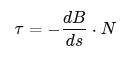
Where tau is the torsion, B is the binormal vector, N is the normal vector, and S is the arc length.
Relationship to the Binormal Vector
The binormal vector B is perpendicular to both the tangent vector T and the normal vector N. As a curve twists through space, the binormal vector rotates. Torsion measures the rate at which this rotation occurs. If B doesn’t change direction, then torsion is zero. The more rapidly that B changes direction, the greater the value of torsion. So, while curvature describes how a curve departs from a line, torsion describes how a curve departs from a plane.
Reflections
I think this is interesting simply for what it does – provides a clear framework for measuring change in 3D space. This is very obvious when thinking about phenomena we can see, like a feather floating through the air, or to envision phenomena we can’t see, like electrons traveling through space. The rules laid out will also apply to other changes that are a result of multiple forces acting upon each other at once. Nothing about this is particularly challenging. I jot down the equations in my notebook, then crunch the math. I like where this is going and look forward to gaining a deeper understanding of where it leads.