

Hermitian & Unitary Matrices
MIT OCW 18.06SC Sections – Lectures & Reading:
Lecture 26: Complex Matrices; Fast Fourier Transform (FFT)
Strang 9.2 – Hermitian and Unitary Matrices
Complex Transpose and Conjugate
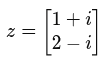
Transposing matrices is foundational in Linear Algebra, as it lets us move between column vectors and row vectors, enabling dot products, performing linear transformations, and determining orthogonality. Furthermore, symmetry depends on transposition. However, when working with complex matrices, transposing alone is not enough. We often must take complex conjugates, replacing i with -i. For a complex vector like
Its conjugate is
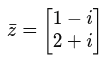
For such matrices, the transpose flips the rows and columns, while the conjugate changes the signs of the imaginary parts. In complex Linear Algebra, these operations are commonly combined…
Superscript H
The superscript H is the conjugate-transpose, like this

This is called the Hermitian transpose or conjugate transpose. The Hermitian transpose of a matrix is found by transposing the matrix and taking its complex conjugate. Take for example:
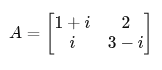
First we transpose it (notice 2 and i switch places)
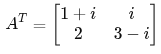
And then we conjugate that transpose by switching the signs of the i constants

The Hermitian transpose is fundamental in complex inner products, Hermitian matrices, and unitary matrices.
Complex Inner Products
In complex vector spaces, the ordinary dot product must be modified. To do so, we use the Hermitian transpose:
This ensures that the lengths and angles behave properly in complex spaces. If we just use ordinary transposes instead of Hermitian transposes, our dot products will often equal zero – a poor description of length.
Take:
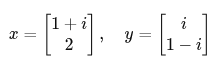
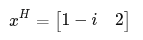
The Hermitian transpose of x is:
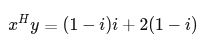
And our dot product is then:
As stated, a complex vector’s length is computed thus:
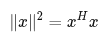
Unlike ordinary transpose products, this will always be real and non-negative.
Hermitian Matrices
A matrix is Hermitian if
This is, as should be evident, the complex version of a symmetric matrix. Real symmetric matrices are a special case of Hermitian matrices.
Take the following real symmetric matrix for example:
Here, the off-diagonal entries are complex conjugates too, so

Key properties of Hermitian matrices:
- diagonal entries must be real
- eigenvalues are always real
- eigenvectors for different eigenvalues are orthogonal
Hermitian matrices are important because they behave very nicely, simplifying things (you know I like simplification), like
- stable geometry
- real measurements
- clean eigenvalue structure
Eigenvalues and Eigenvectors of Hermitian Matrices
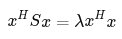
Hermitian matrices have especially nice eigenvalue behavior. If

And S is Hermitian, then all of its eigenvalues are real. Even though the matrix may contain complex numbers, the eigenvalues of these Hermitian matrices remain real. This follows from:
Combined with the fact that

Must be real for Hermitian matrices.
Orthogonal Eigenvectors
Eigenvectors corresponding to different eigenvalues of a Hermitian matrix are orthogonal:

This is the complex version of orthogonality for symmetric matrices.
Diagonalization
Hermitian matrices can always be diagonalized:
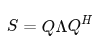
Where
- Q contains orthonormal eigenvectors
- Λ is a diagonal matrix of real eigenvalues
Unitary Matrices
A matrix U is unitary if

This is the complex version of an orthogonal matrix. For real matrices:

This tells us that unitary matrices reduce to orthogonal matrices.
Key properties of unitary matrices:
- columns are orthonormal
- rows are orthonormal
- lengths and angles are preserved
And that Hermitian transpose of a unitary matrix is equal to its inverse:

This makes the inverse easy to compute, as we just transpose and then conjugate. Moreover, vector length is preserved in unitary matrices. So, for any vector x:

Unitary matrices represent
- rotations
- reflections
- transformations that preserve geometry
Observations and Reflections
- The second part of this OCW section was on Fast Fourier Transforms. As in the past, I couldn’t make much use of the parts on Fourier Transforms, as I’d never studied them before. Strang seems to assume a priori proficiency with Fourier Transforms. As my time is precious, I read the section and then moved on.
- Hermitian matrices make sense – basically it’s a construct applied to make our work simpler, and I’m all about simpler. I’d like to see how they’re actually used in real (no pun intended) applications. But then I’d like to start using Linear Algebra, in general, in real world applications.
- Unitary matrices I was a little foggier on. I ‘understand’ them as I do Hermitian matrices. It’s just that with every additional layer of abstraction laid on, I grok what’s going on a layer less.