

Introduction to Vector Functions
Professor Leonard – Calculus 3 – 12.1: Introduction to Vector Functions
12.2: Derivatives and Integrals of Vector Functions
We’re already familiar with parametric equations from previous work in Calculus
- x = f(t), y = g(t) – where t is the parameter from some interval in the common domain
Vector functions are the logical progression into 3D spaces as logically defined by
- x = f(t), y = g(t), z = h(t)
We already know that vectors are defined like this:
- r = xi + yj + zk – where x, y, and z are scalars of the unit vectors <i, j, k>
We simply add complement these to turn them into useful vector functions:
- r(t) = x(t)i + y(t)j + z(t)k
The terminal points of the vectors create a curve through space in the domain of t. Of course, it should almost go without saying that I need to learn how to sketch these equations. While I often struggle with sketching, it does exercise my brain and better help me understand what is happening geometrically. The steps in sketching vector equations are:
- Identify the x, y, z coordinates
- Use one or more components to get a curve or surface
- For 2 components, sketch on a plane
- For 3 components, sketch on a surface
- Use the values of t to find points and orientation of the curve
Limits of Vector Functions
Limits of vector functions are defined similarly to how real-value functions’ limits are defined.
- Let r(t) = f(t)i + g(t)j + h(t)k be a vector function with domain D and limit L at t as t approaches its given limit value
Basically, to evaluate the limit of a vector function, we find the limit of each scalar function.
Derivatives and Integrals of Vector Functions
And finally we’re into the Calculus. So far, nothing really changes in terms of how we differentiate vector functions. That’s to say that the rules of differentiation don’t change. Rather, we differentiate vector functions by each of a function’s individual components, like so

Another way of saying this is that the vector function r(t) = f(t)i + g(t)j + h(t)k has a derivative at t if f, g, and h have derivatives at t. The derivative vector function is

While we’re at it, it’s useful to lay out a few more measurements.
If r is the position vector of a particle moving along a curve, then
- Velocity of the particle’s position derivate: v = v(t) = dr/dt
- Speed is the magnitude of the velocity: Speed = ||v||
- Acceleration is the derivative of of velocity: a = dv/dt = d^2r/dt2
- The unit vector v/||v|| is the direction of motion at time t
I’ve been away from Calculus for a little while so haven’t had all the fuels of differentiation immediately accessible in my RAM. I pulled out my handy notebook with all the rules and identities that I built over Calc 1 and 2, and got to reviewing and practicing. They all apply effectively the same as in differential calculus. Development of the product rule, given that with vectors we have both dot products and cross products are, logically, thus:
- Dot Product Rule: d/dt[u(t) * v(t)] = u’(t) * v(t) + u(t) * v’(t)
- Cross Product Rule: d/dt[u(t) x v(t)] = u’(t) x v(t) + u(t) x v’(t)
Sketching Tangent Lines
Sketching the tangent lines to vector functions took on an extra twist. We can be given a vector function and be tasked with sketching a vector function and the tangent vector to that function, doing so like this:
- Sketching out the vector function (as we’ve recently covered)
- Find a point of tangency at t on the sketched vector function
- Find (and sketch) the tangent vector at the point of tangency
Given my very spatially-challenged mind, this takes some head tilting and rotation at times, as when we draw a tangent vector, we do so relative to our point of tangency, treating it as if it were the origin point.
For example:

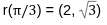
We find the point of tangency at
We then calculate and sketch our tangent vector at the point of tangency, so
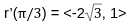
This is a tangent vector starting at the edge of and pointing up and to the left (negative x and positive y).
Integrals of Vector Functions
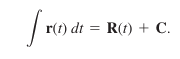
The indefinite integral or r with respect to t is the set of all antiderivatives of r. If R is any antiderivative of r, then
Just like differentiating vector functions, when we integrate vector functions, we do so by component. For example, a definite integral of a vector function could be written thus:

At this point, my only difficulty has been with the rust formed during my time away from Calculus. Coming from the abstract realms of Linear Algebra, it’s been nice to focus my aperture and practice differentiation and integration again. I expect more wonderful headaches to come.