

MIT OCW 18.06SC Sections – Lectures & Reading:
Lecture 21: Eigenvalues and Eigenvectors
Strang 6.1
Early on in Linear Algebra I tried my best to see the study of Linear Algebra as the study of linear transformations, as functions that map vectors from one vector space to another while preserving the operations of vector addition and multiplication. I also try to ‘see’ them as a shape or phenomena that stretch, shrink, flip, shear, rotate, or combine directions. In doing so, I recognize that there is some characteristic or core behavior that stays the same through the transformations.
That’s where eigenvalues and eigenvectors surface.
Eigenvalues and eigenvectors describe the key behavior of linear transformations, especially their ‘natural directions’.
Take the following simple equation:

If matrix A acts of vector x, then the result is a scaled version of x. That scalar multiple is

The eigenvalues is the scaling factor to an eigenvector (wait for it). These eigenvalues reveal the long-term behavior of a system: whether something grows, decays, stays steady, oscillates, or collapses.
Now for x, the eigenvector. It represents the natural direction of a linear transformation. In all

The eigenvector stays the same. Eigenvectors are critical in helping us better understand and diagonalize matrices, and enabling their use in various applications such as Markov chains, differential equations, and data analysis.
To find eigenvalues, we set up an equation as
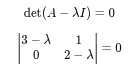
From there it’s straightforward algebra to find the lambda values. Take for example
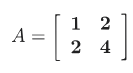

Take the determinant of ad – bc:

Set the determinant equal to 0 and solve for lambda. From this we find the two eigenvalues to be 0 and 5. With the eigenvalues in place, we can now determine eigenvectors.
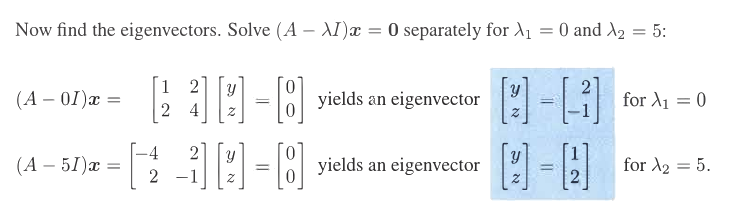
In this example (2, -1) and (1, 2) are the non-zero vectors in the nullspace (eigenspace). Connecting the dots, we find that the sum of eigenvalues is equal to the trace (the main left to right diagonal of a matrix) and that the product of the eigenvalues is equal to the determinant of the matrix.
No doubt, there is much more to come where these concepts come into play. Much of consequential math pertains to change, and the eigenvalues and eigenvectors are descriptors of changes in matrices. So, to be continued…