

MIT OCW 18.06SC Sections – Lectures & Reading:
- Properties of Determinants
- Strang 5.1
- Determinant Formulas & Cofactors
- Strang 5.2
- Cramer’s Rule, Inverse Matrix, & Volume
- Strang 5.3
Hours Spent ~ 20 hours
The determinant has been with me since the beginning of Linear Algebra. We learn almost immediately that it’s an important concept, although we don’t know why. I trusted that in time I’d learn more about it. So it’s been there, but I’ve not given it much inquiry. Then it surfaced at the beginning of Calculus 3 in conjunction with the examination of vectors.
The determinant is a central idea, or node, to the broader study of Linear Algebra. So this section on determinants has been interesting. It’ll continue to sink in. I suspect it’ll continue to resurface as I learn about more concepts that connect to it. For now, let’s have our first look at the properties of determinants.
Properties of Determinants
There are ten properties of determinants. They are:
- The determinant of a n x n identity matrix is 1: This stems from forthcoming properties concerned with the product of pivots. So let’s just leave it as it is for now. It’ll become quite obvious.
- The determinant of a matrix changes signs when rows of the matrix are exchanged: Swapping rows is common in elimination and permutation operations. Each time we swap a set of rows, the determinant of the matrix switches from positive, to negative, or vice versa. So, det(a, b; c, d) = -det(c, d; b, a).
- The determinant is a linear function of each row separately: If a row is scaled, the determinant is scaled, if rows are added, the determinant is added.
- If two rows (or columns) of a matrix are equal, the determinant of the matrix is zero: This gets into the core difference between linearly independent vs dependent rows. Two identical rows means that the rows are linearly dependent, so the rows don’t span the whole space, and the volume collapses. We’ll see more of this in the coming properties. So, essentially det(a, b; a, b) = 0
- Subtracting a factor of one row from another row doesn’t change the determinant of the matrix: This is what we do with elimination – we subtract multiples of an upper row from a lower row to help us make sense of the matrix. The determinant of that matrix never changed, although it might be easier for us to see.
- Any matrix with a row of 0’s in it has a determinant of 0: Like what we saw in property 4, a row of 0’s means a direction vector that has no direction or length, and thus contributes nothing to the span or volume of the matrix.
- If a matrix is triangular, its determinant is the product of its diagonal: So, det(a, b; 0, d) = ad. And as we saw in property 1, the determinant of the identity matrix, a matrix with 1’s in the diagonal and 0’s all around it, is 1 * 1 * 1…, so is 1.
- If a matrix is singular, its determinant is 0. If it’s invertible, it is not 0: This is effectively repeating what we’ve already touched on in previous properties. A singular matrix is one with linearly dependent rows or columns. Such a matrix has rows that amount to nothing and drag the determinant with it. A way to think of it is the construction of a cube from a square with length L, width W, and height H. If one of those three variables is equal to 0, then a cube can’t exist. The volume (i.e. the determinant) is 0. If a matrix is not singular, then it is invertible, and its determinant is not 0.
- The determinant of the product of matrices is equal to the product of their determinants: In a nutshell, det(AB) = det(A) * det(B). Also, as we learn early on in Linear Algebra, a matrix times its inverse yields the identity matrix. The determinant of the identity matrix, as we’ve just noted, is 1. So, det(AA^-1) = det(A) * det(A^-1) = 1
The determinant of a matrix is equal to the determinant of a matrix’s transpose: A transpose of a matrix is a matrix that is flipped over across its diagonal. The elements of that matrix are the same, as so too is the volume or determinant.
To sum up these concepts, as Strang does succinctly in the Review of Key Ideas:
- The determinant of I = 1, signs are reversed when rows are swapped, and linearity is applied to each row
- After elimination, the determinant of a matrix is equal to the +/- product of its pivots
- The determinant of a singular matrix is 0
- The determinant of the product of matrices is equal to the product of their respective determinants
- A matrix’s determinant it the matrix’s transpose’s determinant are the same
- Factoring out multipliers from a matrix leaves its determinants unchanged
Permutation and Cofactors
There are three ways to find the determinant of a matrix.
- Pivot Formula
- Big Formula
- Determinant by Cofactors
The Pivot Formula
This is what we’ve been using in the past. We use elimination to decompose a matrix A into LU. Think of the classic form of a lower triangle L with diagonal of 1’s, and an upper triangle of U with components that remain after elimination. The determinant is equal to the product of the diagonals, or in the case of LU, the product of the determinants of L and U. Given that the determinant of a diagonal of 1’s will be a product of 1, we effectively wind up with the product of the diagonals of U. We take into account row swaps, as mentioned earlier. Our determinant is then the product of the diagonal with appropriate sign adjustments that are to be made as a result of row swaps.
The Big Formula
The Big Formula calculates the determinant as a sum of all row entry products, taking just entry per row. In other words, the determinant of matrix A is equal to the sum of all n! column permutations. Take for example the following 3 x 3 matrix:

Calculating a determinant this way seems pretty impractical to me. But then calculating any real life determinant manually is pretty impractical. Bring out numpy, please.
Cofactor Formula
The determinant is a dot product of any row of a matrix with its cofactors using other rows. Professor Leonard does a fantastic job of teaching this using his arms to block out columns of matrices on the white board. You can see here how if we start with the matrix A, three factors from the top row are multiplied by the determinants of their corresponding cofactors.


It’s both illuminating and interesting to see how these different methods of finding the determinant work, how the different operations are just doing the same thing in a different way. They are different ways of revealing the truth underneath. Although I don’t envision myself performing a Big Rule calculation anytime soon, I now know that by performing a cofactor calculation, I’m adding together the permutation of row-element-products, or am multiplying the pivots and adjusting for row swaps..
Cramer’s Rule, Inverses, and Volumes
Take what I said above and add some salt. No sooner am I illuminated by the three ways of finding a determinant, than I am presented with yet another – Cramer’s Rule.
The lecture to this section didn’t make much sense, nor did the corresponding reading make it clear either. I did some exercises and think I got enough of a gist of what was going on to move on. Rather than make an ass of myself trying to explain what brighter minds failed to clarify, I’ll defer to said brighter minds. Here’s Strang:
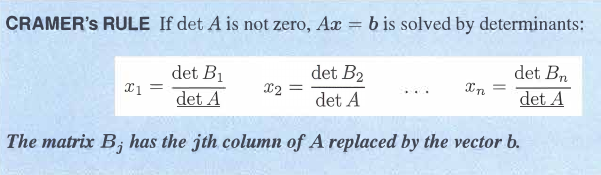
For me, this was difficult to describe. I think if it’s difficult to describe, or if such a description is difficult to understand, then it might be impractical, given more sensible alternatives. So I chewed on Cramer’s Rule for a bit, then moved on
However, this section also touched on cross products, which I also recently covered in Calculus 3. Cross products make better sense, and their utility is much more apparent.
A cross product is a product, not to be confused with the dot product, is an operation on two vectors in a 3D space. It shows how the two interact, yielding a new complementary vector. The magnitude of a cross product (the square root of the sum of its vector components) gives us the area of a parallelogram. And the cross product then allows for triple products, i.e. a cross-product-dot-product, which in turn gives us the volume of three vectors interacting with each other. And what is the volume of three vectors also known as? That’s right, a determinant.
So the latter half of this section does help to tie things up in the determinant unit. Apologies to Cramer, but I just don’t get your rule, or at least see the usefulness of spending my scarce time internalizing it.
At the time of writing, I’ve already begun studying eigenvalues and eigenvectors. I’d been waiting for this for a while, anticipating an important junction in Linear Algebra. It’s fascinating stuff. With a name like eigenvector, I’d expect nothing less.
Stay tuned…