

Professor Leonard – Calculus 3 – 12.4: Velocity & Acceleration of Vector Functions
Thomas – 13.5 Tangential & Normal Components of Acceleration; 13.6 Velocity & Acceleration in Polar Coordinates
We’ve seen velocity and acceleration before, so the concept is essentially a review. Velocity is the rate of change of position, given by
v(t) = r’(t)
And acceleration is the rate of change of velocity, given by
a(t) = v’(t) = r’’(t)
Speed is the magnitude of velocity, like this:

So, velocity is a vector, but speed is a scalar.
Velocity, Acceleration, and Speed in Polar Coordinates
In rectangular coordinates, the unit vectors i, j, and k stay fixed. However, in polar coordinates ur and u move with the particle
- ur points away from the origin
- u moves in the direction of the changing
The polar position vector r = rur . Velocity is expressed like this:
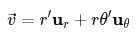
While acceleration is expressed as

The terms look strange compared to our TNB frames, but that’s because the vectors are rotating as the particle moves. I’ll simply trust that mathematicians much smarter than I figured this stuff out so that I can simply plug in numbers and crunch.
In a nutshell, a TNB frame is organized around the curve, while the polar frame is organized around the origin. Beyond that, the concepts of velocity and acceleration are the same. Nothing complicated to see here.