

MIT OCW 18.06SC Sections – Lectures & Reading:
Lecture 22: Diagonalization & Powers of A
Strang 6.2
Diagonalizing a matrix is rewriting it in a form such as

Where D equals a diagonal matrix of eigenvalues and P contains the corresponding eigenvectors. Strang writes it like this:
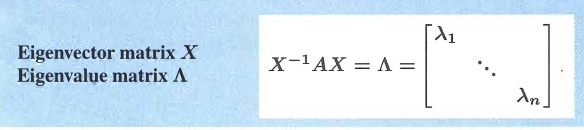
Where capital lambda is the matrix and the X’s contain the eigenvectors.
Diagonalizing allows us to perform exponential matrix operations that would otherwise demand cumbersome matrix multiplication. It also unlocks long-term operations, like those forthcoming Markov processes. This is important because matrix multiplication gets messy, especially when done manually where it becomes very prone to error (at least it does for absent-minded me).
As I covered in previous entries, eigenvectors represent a direction that doesn’t change over the course of linear transformations, and eigenvalues are simply scaling factors. For an nxn matrix, we need n independent eigenvectors. In order for this to all work, all the columns of a matrix must be linearly independent, for, as noted, A demands that the eigenvectors are invertible. WIth diagonalization, we can calculate

as follows:
- Find the eigenvalues
- Find the eigenvectors
- Build P and D
- Diagonalize A
- Compute our wanted power
Let’s start with the simple matrix

→
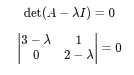
→
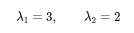
We find our eigenvectors to be


And now we plug in the v’s to form P
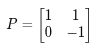
While we’re at it, we can find P inverse, which just so happens to be:
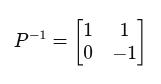
Our diagonal matrix of eigenvalues is:

And because D is diagonal, we simply raise each diagonal entry to the k-th power:
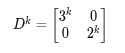
Now we have everything we need
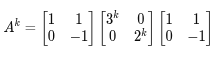
Finally we have
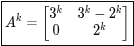
Without diagonalization, computing large exponentials of matrices would be a cumbersome slog. But this amazing shortcut can be done simply by calculating our eigenvalues and eigenvectors, raising the diagonal entries to powers, and then reconstructing the clean answer. Math is beautiful.