

Cylindrical and Spherical Coordinates
Professor Leonard – Calculus 3 – 11.7 Using Cylindrical and Spherical Coordinates
Now that we’ve had a look at cylinders and quadric surfaces, we switch our attention to effective ways of describing them in equations. Rather than using (x, y, z) style rectangular coordinates, many 3D objects are easier to describe using cylindrical and spherical coordinates.
Cylindrical Coordinates

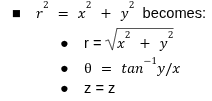
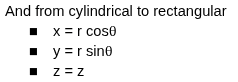
Cylindrical coordinates are essentially polar coordinates with an added height coordinate z, and r equal to the distance from the origin to the projection of the point on the xy plane. Cylindrical coordinates are appropriate when the shape has circular symmetry around an axis, usually the z-axis. We can convert back and forth between rectangular coordinates and cylindrical coordinates quite easily.
Spherical Coordinates

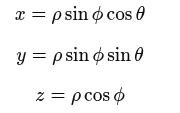
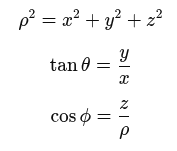
Spherical coordinates describe points using distance from the origin and two angles. Rho is the distance from the origin to the point in question, theta is the angle in the xy plane, just as with polar and cylindrical coordinates, and phi is the angle down from the positive z axis. Like with cylindrical coordinates, we can convert between spherical coordinates and rectangular coordinates in the following way:
Spherical to rectangular coordinates conversion:
Rectangular to spherical coordinates conversion:
Big Idea: We use cylindrical and spherical coordinates to make equations, bounds, and integrals simpler. We use cylindrical coordinates when the problem is naturally circular around the x-axis. We use spherical coordinates when the problem is naturally centered around a point, like a sphere.
Now, onward to where this starts to get fun, with vector functions…