

Cylinders and Quadric Surfaces
Professor Leonard – Calculus 3 – Cylinders and Surfaces in 3D
Prior to moving into what will surely be the examination of change in patterns we can describe geometrically, we first look at the types of shapes that we’ll be encountering moving forward. They are divided into two types: cylinders and surfaces. In this section we learn to identify the equations corresponding to the different cylinders or surfaces, and then envision what they look like. We do that by breaking out the graph paper and draw (or do our best to draw) the forms given in the equations. While no Calculus was done here, it is clear to me that it’s important to become familiar with these geometrical manifestations. So, here we go…
Cylinders
First, it’s important that we discard our preconceptions of cylinders as 3-dimensional, tin can like prisms. As it pertains to this topic, they are not that.
Cylinders are defined by equations that always have two variables, and are directed along the axis of the missing variable. So, for example, if you’re given x and y variables, the cylinder will straddle the z axis. The curve or trace does not change along this axis. It might be a continuous shape, like an elongated semi-circle or ellipse, or might be discontinuous, breaking at asymptotes. We can sketch cylinders relatively easily.
Steps for Sketching Cylinders:
- Identify the two variables benign traced, and the axis along which they’ll be traced
- Plug some numbers in and plot the corresponding points
- Sketch!
Quadric Surfaces
Quadric surfaces have three variables. Traces occur on coordinate planes and/or on planes parallel to the coordinate planes. They’re still directed along an axis, but traces change along that axis.
Steps for Sketching Quadric Surfaces:
- Determine the type of surface and the direction axis
- Find traces on the coordinate plane
- Find at least two other traces along the direction axis
- Sketch!
Types of Quadric Surfaces
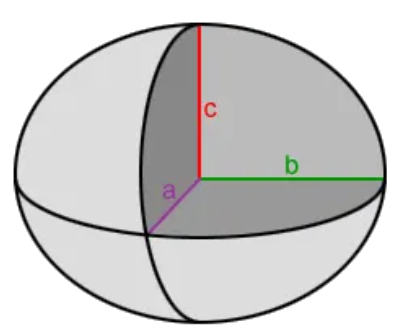
Ellipsoids (deformed spheres)

- All variables are positive and squared
- Equations always include a constant
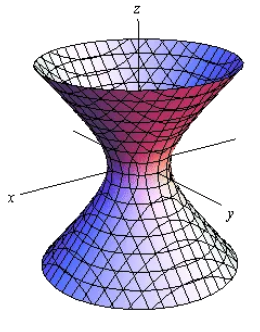
One-Sheet Hyperboloid

- One variable is negative
- Directed along the negative variable’s axis
- All variables are squared
- Equations always have a constant
Two-Sheet Hyperboloid

- One positive variable and two negative variables
- Directed along the positive variable’s axis
- All variables are squared
- Equations always have a constant

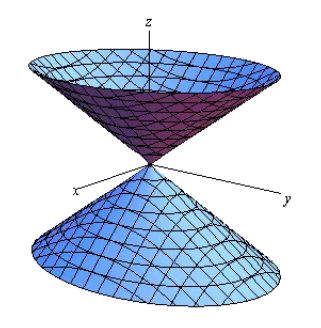
Cone

- Two positive variables and one negative variable
- Directed along the negative variables axis
- All variables are squared
- Equations have no constants
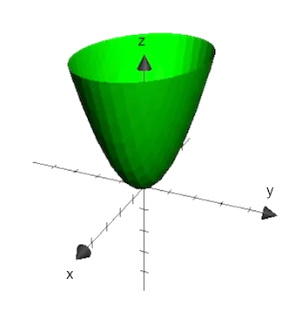
Paraboloid

- Three variables
- Two variables which are squared and must be positive
- One variable of power one can be positive or negative
- Directed along the variable with power one
- If this variable is positive then it opens toward the positive axis, if negative it opens toward the negative axis
Hyperbolic Paraboloid

- Three variables
- Two variables are squared, of which one is negative
- Directed along the axis of the variable of degree one
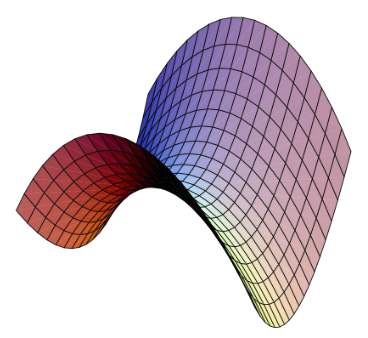
OK, these were fun to graph. It’s going to get ugly, because picturing shapes in my mind is a weak point. I had a very difficult time tracing the hyperbolic paraboloids – but look at it, can you blame me? What doesn’t kill me makes me stronger.