

The Cross Product
Professor Leonard – Calculus 3 – 11.4 ‘The Cross Product’
Thomas – 12.4 ‘The Cross Product’
I apologize to you, the vacuum of non-readership, and me, the perpetrator and victim, for my blogging neglect. It’s happened again – I let the blogging slip behind. I’ll touch on the bigger picture of what’s been going on in my life elsewhere. For the purposes of my ongoing math record, let me say that when I finally stopped what I’d been doing to catch up, I realized how far ahead I’d let myself run. Far. This catchup has taken days – and that’s just you outline these forthcoming blog entries. Now that they’re done, and the writing is beginning, I’m glad to have done them. Translating math into brutish verbal language does much to reinforce and solidify learning.
I was pleasantly surprised when I encountered this section early on in Calculus 3. I was happy because it’s something I’d studied not long before in Linear Algebra. It’s great to see the different spaces touch each other, like bubbles joining.
In Linear Algebra we use cross products of matrices as a means for finding the determinant via cofactors. The cross product is a multiplication of vectors, resulting in a new vector that is orthogonal to both factors of the product. Its application here in Calculus allows us to determine the tilt of a place. Two vectors frame a plane. The cross product of those vectors gives us a third orthogonal vector which tells us the inclination of said plane.
For a 2 x 2 matrix (a, b; c, d), our cross product is like this
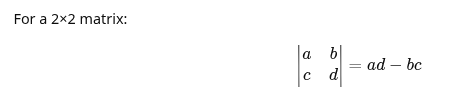
ad – bc is the determinant of this matrix.
For a 3 x 3 matrix, I’ll borrow from Thomas
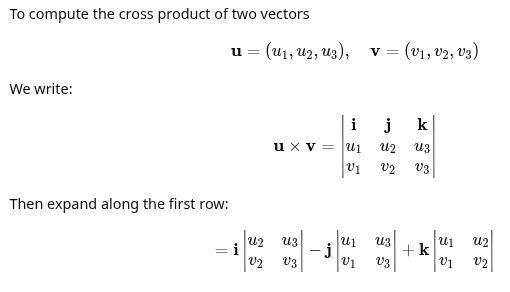
Basically, you could think of this as putting your finger over one row, then performing a 2×2 matrix cross product on the remaining vector coordinates, and multiplying that by the unit vector (i, j, or k) which you’d just blocked out. As the great Izzy Tooinsky would say, “no problem!”
The cross product comes in very handy in Calculus as it does in Linear Algebra. If a cross product will define a plane in 2D space, then it will also tell us the area of the parallelogram (plane) it frames.
So, if u x v = <a, b, c>, then the magnitude is:
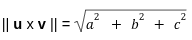
Another way to think of it is as the determinant

or rather the absolute value thereof. Which, as we’ve learned before, the determinant gives us the area of a 2 x 2 matrix.
I’m using a picture to demonstrate what I mean. Note, the book has been sloppy and used single pipes for magnitude.
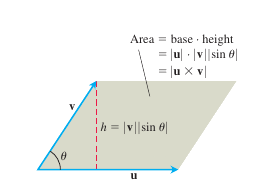
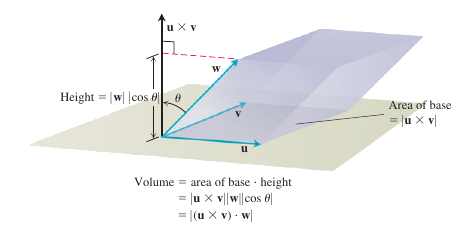
Correspondingly, we can find the area of a triangle by ½|| u x v||. Knowing what we do about 3-dimensional prisms, we can extend the use of the cross product to calculate volume. If the cross product gives us the area of the base, then multiplying that by the height of a figure gives us the volume. We can find that height with a little trig, like so:
Given the mental labor I’ve undergone cogitating Linear Algebra, it was awesome to see what I was doing applied from a different perspective and have it immediately make sense. I’m giddy with anticipation to find out more about how Calculus and Linear Algebra overlap and how they can be used together. More to come!